
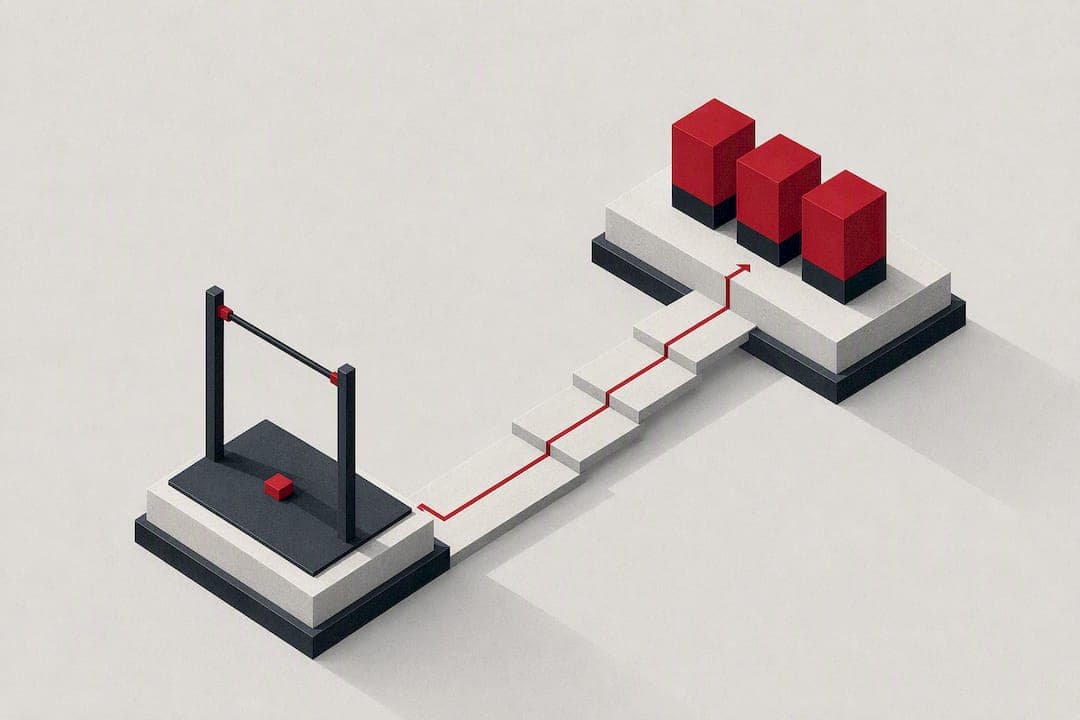
A scapular pull-up is a dead-hang drill where you depress and retract your shoulder blades without bending your elbows, building the stability your body needs before it can pull real weight. It's the missing link between a passive dead hang and a controlled pull-up, and it belongs in your warm-up whether you're chasing your first rep or your fiftieth. Beginners, rehab clients, and seasoned lifters all use it the same way: as a foundation, not a finisher.
TL;DR:
- Scapular pull-ups should be performed every pulling session to develop shoulder blade control crucial for effective pull-up progress.
- Incorporating holds and slow tempo reps helps build stability, with hold durations extending only once control feels effortless.
- Using band-assisted or wall variations makes the exercise accessible for those who struggle with full bodyweight movements initially.
- Proper form requires keeping elbows straight, shoulders depressed, and avoiding swinging or shrugging to ensure targeted muscle activation.
- Progress can be tracked by holding control for at least 10 seconds unassisted and completing multiple sets of controlled reps without assistance.
Table of Contents
- What Do Scapular Pull-Ups Train?
- How to Do Scapular Pull Ups With Proper Form
- Common Mistakes That Kill Scapular Pull-Up Form
- Programming Scapular Pull-Ups Into Your Routine
- Scapular Pull-Up Variations and Regressions
- Warming Up for Scapular Control
- Coaching Notes on Tracking Your Scapular Pull-Up Progress
- Sources
What Do Scapular Pull-Ups Train?
Scapular pull-ups target the small muscles that control shoulder blade movement, the ones most lifters never train directly. Your lats do the heavy lifting in a full pull-up, but they can't work efficiently if your scapulae are floating loose in the socket.
The primary muscles worked include:
- Lower trapezius, which pulls the shoulder blade down and controls the depression phase
- Rhomboids, which draw the shoulder blades together during retraction
- Serratus anterior, which stabilizes the shoulder blade against the rib cage
- Latissimus dorsi, working as a secondary driver once the scapula is set
This is a skill and stability exercise, not a mass builder. A scapular pull-up guide from MasterClass confirms the movement builds the activation foundation your body needs before attempting full pull-up mechanics. You're not going to add inches to your back from scap pulls alone, but you'll fix the mechanical leaks that stall your pull-up progress for months.
How to Do Scapular Pull Ups With Proper Form
Grab the bar with a shoulder-width, overhand grip and let your body hang fully extended. Arms straight, ribs slightly tucked, legs together. This dead hang is your starting and ending position for every rep.
- Set your tension first. Squeeze your glutes and brace your core lightly so your body doesn't swing.
- Depress and retract. Without bending your elbows, pull your shoulder blades down and back, as if you're stuffing them into your back pockets.
- Hold the top briefly. Your chest should rise slightly and your torso will travel upward a small amount, a small but controlled range of motion. That's the entire range of motion.
- Return under control. Let your scapulae rise and separate again, back to a full dead hang, over 2 to 3 seconds.
- Repeat for reps or hold. Cycle through controlled reps, or pause at the top for a timed hold.
Breathe out on the retraction, in on the release. Slow tempo work, roughly 2 seconds up and 3 seconds down, teaches control faster than speed reps ever will. Once holds feel stable, layer in tempo variations to keep building capacity.
Two cues fix most people's form instantly: think about trying to "bend the bar" slightly with your hands, which fires the lats and lats accessories into position, and picture pulling your shoulder blades toward your back pockets rather than shrugging anything upward.
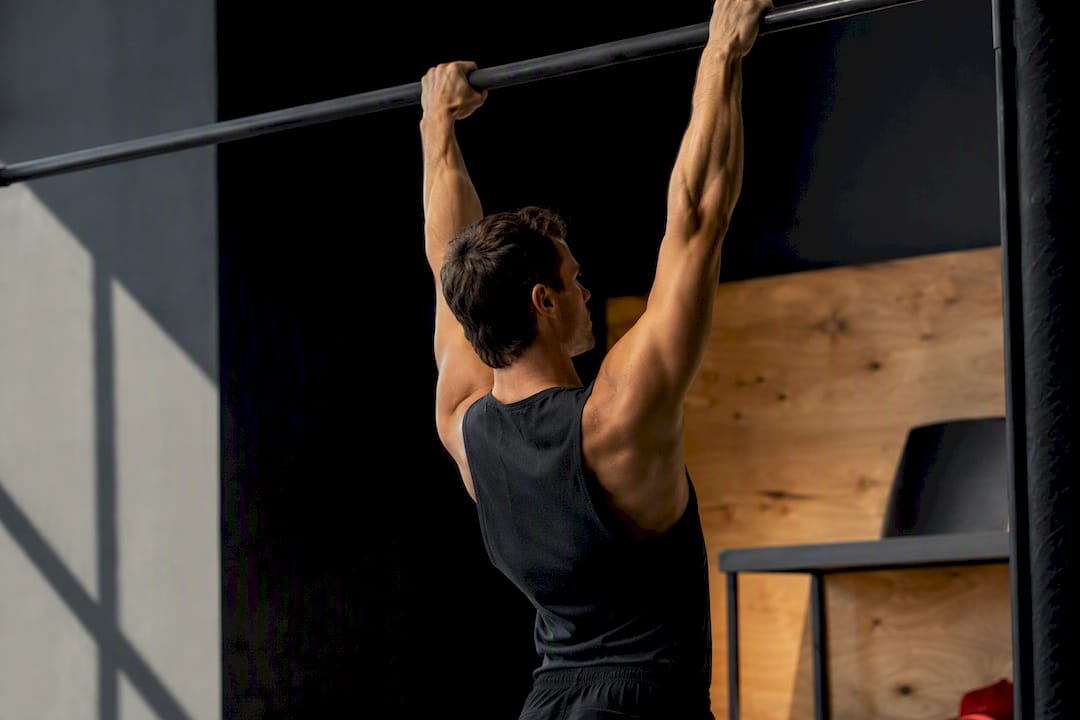
Pro Tip: If you can't feel your shoulder blades moving at all, place two fingers on your traps just below your neck while you attempt a rep. You should feel that area stay soft while the muscles lower down your back do the work.
Common Mistakes That Kill Scapular Pull-Up Form
Most people turn this drill into a mini bicep curl without realizing it. Watch for these breakdowns:
- Bent elbows. Any elbow flexion turns this into a partial pull-up, not a scapular drill. Keep arms locked straight and regress to shorter range if you can't maintain it.
- Shrugging toward the ears. This is the opposite of depression. If your shoulders climb up instead of pulling down, you're using upper traps, not lower traps.
- Swinging or kipping. Momentum hides weak scapular control. Reset from a dead hang and slow the tempo until the swing disappears.
- Grip giving out first. If your forearms fail before your shoulder blades fatigue, switch to a neutral grip or add a resistance band under your feet for assistance.
Film yourself from the side once. Most lifters are shocked to see how little actual movement happens when they thought they were "really pulling."
Programming Scapular Pull-Ups Into Your Routine
Scapular pull-ups work best as a primer, not a main lift. Exercise libraries typically program them as warm-up sets of 1 to 3 sets of 10 to 15 reps, or as isometric work using 3 to 5 holds of 5 to 10 seconds each.
- Frequency: Every pulling session, or as light daily practice if you're rebuilding shoulder control after time off.
- Placement: Right after your mobility warm-up, before grip-intensive or loaded pulling work.
- Progression path: Extend hold duration first, then slow your tempo, then remove any band assistance, then add total volume.
- When to move on: Once holds feel locked in and effortless, spend more training time on loaded pulling work for hypertrophy. Scapular pull-ups stay in your warm-up, they just stop being the focus.
Short, frequent sets groove the pattern without draining the energy you need for heavier back and grip work later in the session.
Scapular Pull-Up Variations and Regressions
Not everyone starts at full bodyweight capacity, and that's fine. Match the variation to where you're actually at.
- Band-assisted scapular pull-ups: Loop a resistance band around the bar and under your feet or knees to offload bodyweight while you learn the pattern.
- Wall scapular pulls: Stand facing a wall, press palms flat, and practice the same depression and retraction pattern without hanging at all.
- Scapular pulldowns: Using a cable machine or a band anchored overhead, mimic the movement in a seated or standing position, useful when grip strength is the limiting factor.
- Australian rows: A horizontal row under a bar or rings builds the same scapular retraction pattern with less grip demand.
- Advanced options: Extend holds past 10 seconds, switch to neutral or supinated grips, or slow your tempo to 4 to 5 seconds per direction.
Warming Up for Scapular Control
A short mobility sequence before scapular pull-ups reduces strain and improves the quality of every rep that follows.
- Dead hangs for 20 to 30 seconds to decompress the shoulders and test grip readiness.
- Wall slides to open the thoracic spine and rehearse overhead positioning.
- Scapular controlled articular rotations (CARs) to move the shoulder blade through its full range before loading it.
- Thoracic rotations and push-plus drills to prep the serratus anterior and upper back mobility together.
Pairing mobility with stability work is exactly what the scapular stabilization research from Hinge Health points to as the most effective combination for lasting shoulder control. Run this sequence, then move into scapular pull-ups, then your main pulling work. If you feel sharp or pinching pain rather than normal tightness, stop and check with a clinician before progressing further, a distinction backed by research on scapular muscle function.
Coaching Notes on Tracking Your Scapular Pull-Up Progress
Consistency is the real marker of progress here, not intensity. Watch for two benchmarks: a clean, unassisted 10 second hold with zero elbow bend, and eventually a strict 3 sets of 10 reps performed with full control and no band assistance.
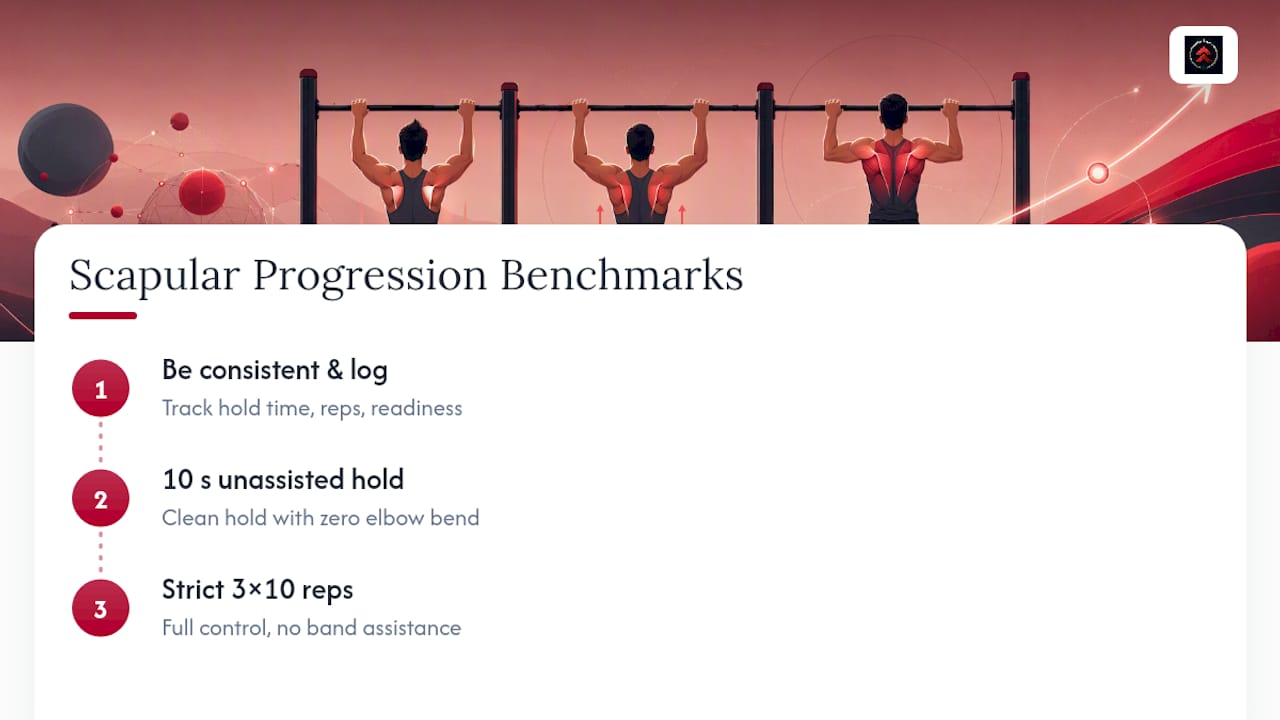
Logging matters more than most lifters expect. Track hold time, rep count, and how you rate your readiness each session, then look for the trend line rather than any single workout. A plateau in readiness scores usually means your small scapular stabilizers need a lighter week before you push volume again. PlayThenics is built around exactly this kind of pattern tracking, flagging trends in your hold times and rep consistency so you catch a stall before it turns into a setback.
Once your scapular control is solid, that stability transfers directly into your pull-up progression work. The shoulder blade control you build here is what keeps your first strict pull-up clean instead of shaky.
— Salah
Sources
- Scapular pull-ups guide — MasterClass
- Scapular stabilization exercises — Hinge Health
- Scap pull-up — Catalyst Athletics