
A properly structured calisthenics warm up is a short, phase-based routine, roughly 8 to 13 minutes, that raises your core temperature, primes the wrists, shoulders, and hips, and rehearses the exact movement patterns you're about to train. Skip static stretching before your working sets. If time is tight, a compressed 6-minute version still beats skipping the process entirely.
TL;DR:
- The warm-up should progressively target the specific joints and movement patterns for the day's session to prevent injury and optimize performance.
- Wrist, shoulder, and hip protocols must use gradual loading and mobility drills rather than static stretches, which can weaken immediate force output.
- Adjust warm-up duration based on training intensity, weather, age, and recovery status, with longer routines before high-skill or cold-condition sessions.
- Incorporating movement-specific activation and joint mobility into the warm-up significantly reduces the risk of lingering stiffness and joint discomfort.
- Using training data to personalize warm-up length and exercises can prevent over- or under-preparing, ultimately supporting consistent progress and injury prevention.
Table of Contents
- What Does A Calisthenics Warm Up Actually Look Like?
- How Do You Warm Up Wrists, Shoulders, And Hips For Calisthenics?
- What Warm-Up Activation Fits Your Training Day?
- Which Warm-Up Length Fits Your Schedule Today?
- When Should You Extend Your Warm-Up?
- How PlayThenics Uses Your Training Data To Personalize Warm-Ups
- Why Warm-Ups Are The Difference Between Progress And Plateau
- A Smarter Way To Dial In Your Warm-Up
- Sources
- FAQ
What Does A Calisthenics Warm Up Actually Look Like?
Forget generic arm circles and a lazy jog around the block. A calisthenics warm-up is built in four distinct phases, each with a job to do. The order matters as much as the content, because each phase sets up the next.
The physiological logic is straightforward: raising your muscle temperature by roughly 1 to 2 degrees Celsius improves contractile force and elastic recoil, which is exactly why cold muscles feel sluggish and stiff on your first working set.
Phase 1: General cardio activation (2 to 3 minutes)
Get your heart rate up and blood moving into working tissue. Pick one:
- Jump rope at a moderate pace
- Light jog in place or around your training space
- High knees combined with butt kicks
None of this needs to be exhausting. You're raising temperature, not burning your first set of energy before you've even started.
Phase 2: Dynamic stretches that preserve power (4 to 6 minutes)
This is where a lot of practitioners get it backward. Static stretching, holding a hamstring stretch for 30 seconds, for example, actually reduces force output when performed immediately before strength work. Systematic reviews on warm-up protocols confirm this: dynamic movement improves performance, while static holds before heavy or skill work can leave you weaker on your first rep.
Run through these instead:
- Leg swings, front to back and side to side, 10 reps per leg
- Inchworms into a light push-up, 6 to 8 reps
- Thoracic rotations in a quadruped or lunge position, 8 reps per side
- Walking lunges with a torso twist, 8 to 10 steps
Phase 3: Joint mobility (specific drills, covered in depth below)
This phase targets the wrists, shoulders, and hips directly, since these three joint complexes absorb the most stress in bodyweight training and get neglected in most generic warm-ups.
Phase 4: Sport-specific activation (2 to 4 minutes)
Now you rehearse the actual patterns. Scapular push-ups, dead hangs, glute bridges, and hollow holds all belong here, since they wake up the exact stabilizer muscles you're about to lean on.
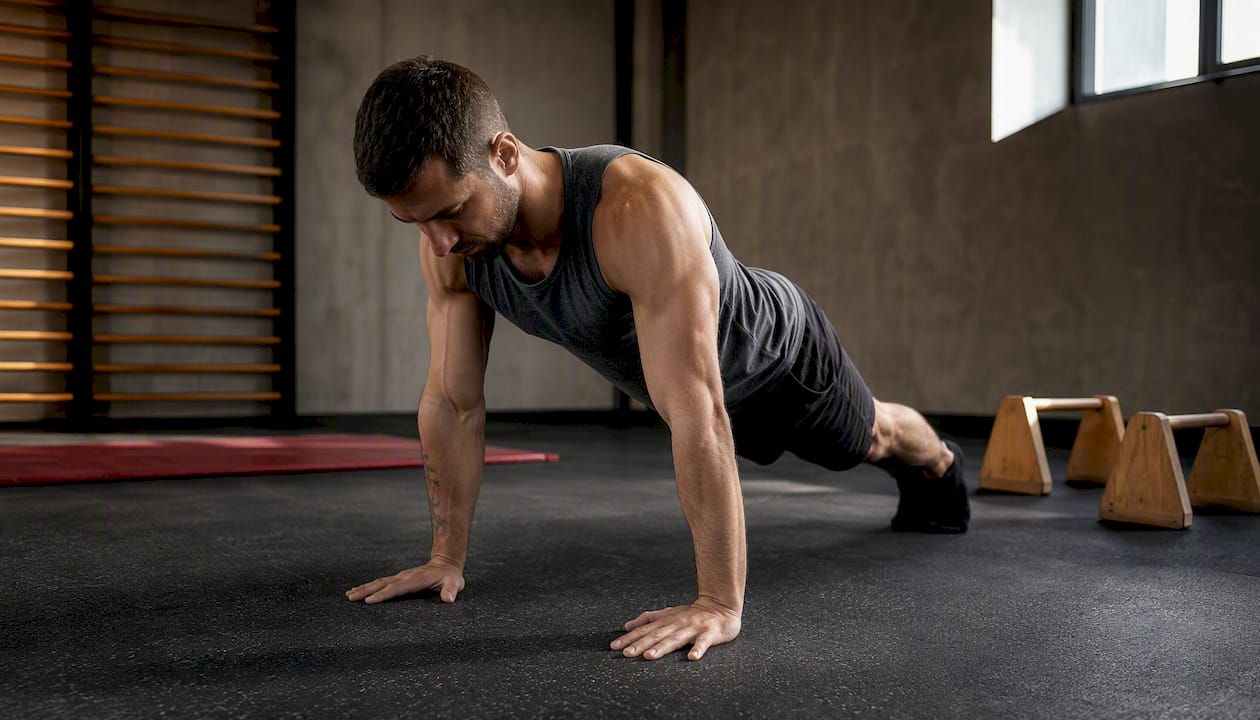
The single biggest mistake in this phase is pushing intensity too high. Keep your effort at a Rate of Perceived Exertion (RPE) of 4 or below on a 10-point scale. Anything harder starts to pre-fatigue the muscles you need fresh for your working sets, which defeats the purpose of warming up in the first place. If your first pull-up feels weaker than your third, your warm-up was too aggressive.
How Do You Warm Up Wrists, Shoulders, And Hips For Calisthenics?
These three joints do the heavy lifting (literally) in almost every calisthenics movement, and each needs its own progressive protocol rather than a quick generic stretch.
Wrist protocol
Wrists are the most commonly neglected joint in bodyweight training, and they're also the first thing to complain when you push into planche work, handstands, or high-volume push-up sessions. Research on upper-body warm-up protocols backs a progressive loading sequence rather than jumping straight into weight-bearing positions:
- Wrist circles, 10 reps each direction
- Fingertip loading against the floor, 20 to 30 seconds
- Palm-down rocks with straight arms, 10 reps
- Loaded wrist rocks (shifting body weight forward and back on flat palms), 8 to 10 reps
Building wrist tolerance through partial-range, progressive loading over several weeks works far better than grinding through long static holds every session.
Shoulder protocol
The shoulder is your most mobile joint and also your least stable, which is exactly why scapular control matters more here than raw range of motion:
- Arm circumduction (big arm circles), 10 reps each direction
- Band external rotations, 12 to 15 reps
- Arm dislocates with a strap or towel, 8 to 10 reps
- Scapular push-ups and scapular pulls on a bar, 8 to 10 reps each
Hip protocol
- Hip rocking in a tabletop or 90/90 position, 10 reps per side
- Glute bridges, 12 to 15 reps
- Deep squat holds, 30 to 45 seconds, shifting weight gently side to side
Pro Tip: Tolerable discomfort feels like tension or a mild stretch that eases within a few reps. Sharp, localized pain that gets worse with repetition means stop immediately. That distinction alone prevents most self-inflicted warm-up injuries.
What Warm-Up Activation Fits Your Training Day?
The activation phase should mirror whatever you're about to train. A warm-up built for pulling does little for a heavy squat session, and vice versa.
-
Push day: Start with incline push-ups against a wall or bench to gradually load the shoulders and elbows. Add scapular push-ups for shoulder blade control, then finish with the wrist rocking sequence from above since pressing movements load the wrists directly.
-
Pull day: Dead hangs from a bar, 2 sets of 15 to 20 seconds, come first to prep the shoulder capsule and grip. Follow with scapular pulls (retracting the shoulder blades without bending the elbows), then band-assisted rows or pull-up negatives at low intensity to rehearse the actual pulling pattern.
-
Leg day: Ankle circles and controlled dorsiflexion drills come first, since ankle stiffness quietly limits squat depth for a lot of practitioners. Add hip activation (glute bridges, lateral band walks if you have one) and finish with two or three sets of bodyweight squats at increasing depth.
-
Skill days (handstands, planche, muscle-ups): These sessions demand more from wrists and shoulders than any other day, so extend those protocols rather than rushing through them. Add hollow holds to prime core bracing, then rehearse the actual skill at low intensity or with a regression. A handful of coaches also use short, CNS-activating moves, like a scorpion stretch or a light medicine ball slam, to sharpen focus before heavy pulling work.
Practicing the movement itself at submaximal effort, sometimes called neural rehearsal, tends to improve technical execution on skills like handstands and planche more than temperature increase alone. If you're building toward your first handstand or refining your pull-up progression, this rehearsal phase deserves as much attention as the joint prep before it.
Which Warm-Up Length Fits Your Schedule Today?
Not every session allows for a full 10-minute warm-up, and that's fine as long as you respect the phase order rather than cutting entire blocks.
| Template | Duration | Best For |
|---|---|---|
| Short | 6 minutes | Time-crunched sessions, light training days |
| Standard | 10 minutes | Most regular training sessions |
| Extended | 12 to 15 minutes | Skill days, cold weather, age 40+, returning from a break |
Short (6 minutes): One minute of light cardio, two minutes of dynamic stretching, two minutes of joint prep hitting only the joints you'll load that day, one minute of movement-specific activation. Keep everything at low intensity since there's no room to burn energy on extras.
Standard (10 minutes): Full four-phase structure as outlined above, with 2 to 3 minutes of cardio, 4 to 6 minutes of dynamic stretching and joint prep combined, and 2 to 4 minutes of activation.
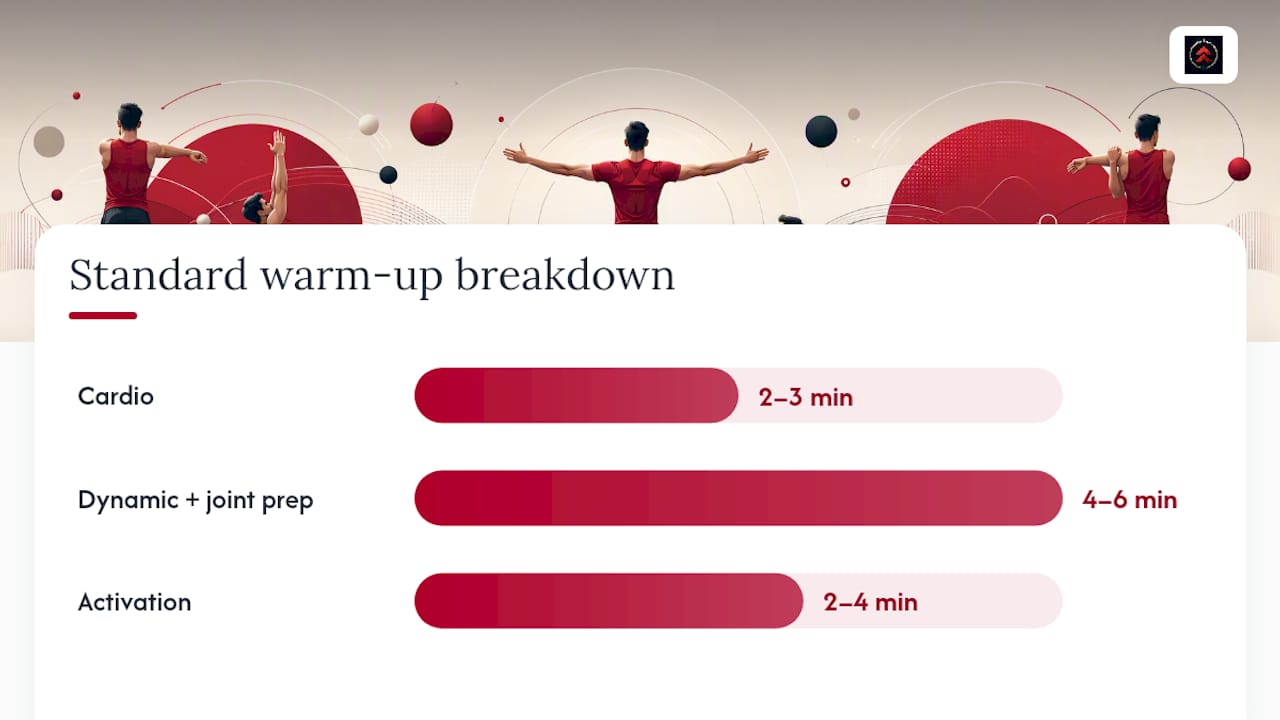
Extended (12 to 15 minutes): Same structure, with extra time added to joint mobility, particularly useful before handstand or planche training, or beginner programs where movement patterns are still new to the nervous system.
If your first working set still feels stiff, you under-warmed. If it feels flat or fatigued, you over-warmed. Both are correctable next session.
When Should You Extend Your Warm-Up?
Certain conditions call for more time in the joint-prep and activation phases, not less. Add 3 to 5 minutes when:
- You're over 40, since connective tissue recovers slower and joints need more preparation time.
- Training in cold weather or an unheated space.
- Returning from more than a week off training.
- Tackling a high-skill session (handstands, muscle-ups, planche work).
Common mistakes to fix: Skipping joint prep entirely and going straight to cardio. Holding static stretches before heavy sets. Warming up so hard you fatigue the exact muscles you need fresh.
Pro Tip: Ramp your warm-up sets progressively into your working intensity, something like two light sets followed by one moderate set at roughly 50 to 60 percent of your intended effort. This tunes your nervous system without pre-fatiguing your prime movers.
Sharp pain, tingling, numbness, or joint instability during warm-up are signs to stop and consult a clinician rather than pushing through.
How PlayThenics Uses Your Training Data To Personalize Warm-Ups
A generic warm-up template treats every session the same. Your actual body doesn't. PlayThenics logs your sets, tracks recovery patterns, and surfaces trends that a static routine simply can't account for.
- A string of missed personal records after normal-feeling sessions can signal you need more general cardio activation, not just joint prep.
- Rising soreness trends around the shoulders or wrists flag the need for extended prep before your next push or pull day.
- Performance dips on skill-specific lifts (handstand holds, muscle-up attempts) often show up in your logged data before you consciously notice fatigue.
- Ahead of a logged handstand or planche session, the app can prompt you to prioritize wrist and shoulder work based on your own history with those movements.
None of this replaces judgment. It sharpens it, using your own numbers instead of a one-size-fits-all script.
Why Warm-Ups Are The Difference Between Progress And Plateau
The practitioners who stall out rarely have a programming problem. They have a consistency problem, and it usually starts with the warm-up being the first thing cut when a session feels rushed. I've watched the same pattern repeat across countless training logs: a skipped shoulder warm-up here, a rushed wrist prep there, and six weeks later the same shoulder impingement or wrist ache shows up again, always framed as a "sudden" injury that was actually months in the making.
Here's the habit that actually moves the needle: log your warm-up adherence and your first-set quality for 30 straight sessions. Not your whole workout, just those two data points. Patterns emerge fast, and they're usually uncomfortable to look at.
Treat the warm-up as part of the set, not a chore before it. Mastery isn't built in the working sets alone. It's built in the minutes that make those sets possible.
— Salah
A Smarter Way To Dial In Your Warm-Up
Most calisthenics athletes build their warm-up once and never touch it again, even as their bodies, skill level, and recovery patterns change month to month. PlayThenics takes a different approach: it uses your logged sets, recovery status, and performance trends to flag exactly when your warm-up needs to shift, whether that means extra wrist prep before a handstand session or a shorter routine on a low-fatigue day.

Say your dead hang times have been dropping for two weeks straight while your logged soreness ratings creep up around the shoulders. That's a pattern worth acting on, and it's the kind of signal PlayThenics surfaces automatically instead of leaving you to notice it three injuries later. The app lets you start logging sessions and tracking these trends immediately, with advanced coaching features available in a subscription tier for anyone who wants recommendations built directly into their training plan. Start tracking your training with PlayThenics and see what your own data says about your warm-up.
Sources
- Fradkin AJ, et al. Effects of warming-up on physical performance: a systematic review with meta-analysis
- McCrary JM, et al. Effects of warming-up on physical performance: a systematic review with meta-analysis (2015)
- Best Warm-Up Routine for Calisthenics (2026 Complete Guide) – Calisthenics Association
FAQ
What Is The 80/20 Rule In Calisthenics?
The 80/20 rule in calisthenics generally refers to spending most training time on foundational strength movements and skill progressions, and less on accessory work or mobility. Applied to warm-ups specifically, it means the bulk of your prep time should go toward the joints and patterns your session actually demands, not scattered generic stretching.
What Are 5 Warm-Up Exercises For Calisthenics?
Five solid choices are jump rope or light jogging for general cardio, arm circles for shoulder prep, wrist circles with fingertip loading, dead hangs for grip and shoulder capsule prep, and glute bridges for hip activation. Together they touch all four warm-up phases in under 10 minutes.
What Are The Big 5 Of Calisthenics?
The "big 5" typically refers to the five foundational bodyweight movements: pull-ups, push-ups, dips, squats, and leg raises (or a core-focused variant like the hollow hold). Your warm-up should activate whichever of these you're training that day rather than covering all five every session.
What Should I Do First In Calisthenics Training?
Start with general cardio activation for 2 to 3 minutes to raise your core temperature, then move into dynamic stretching before touching joint mobility or skill-specific activation. Never begin a session with static stretching or jump straight into your heaviest set cold.
How Long Should A Calisthenics Warm Up Take?
A standard calisthenics warm up takes about 8 to 13 minutes, though a 6-minute compressed version works when time is limited, and 12 to 15 minutes fits skill days, cold weather, or anyone over 40. The exact length matters less than covering all four phases in order.